
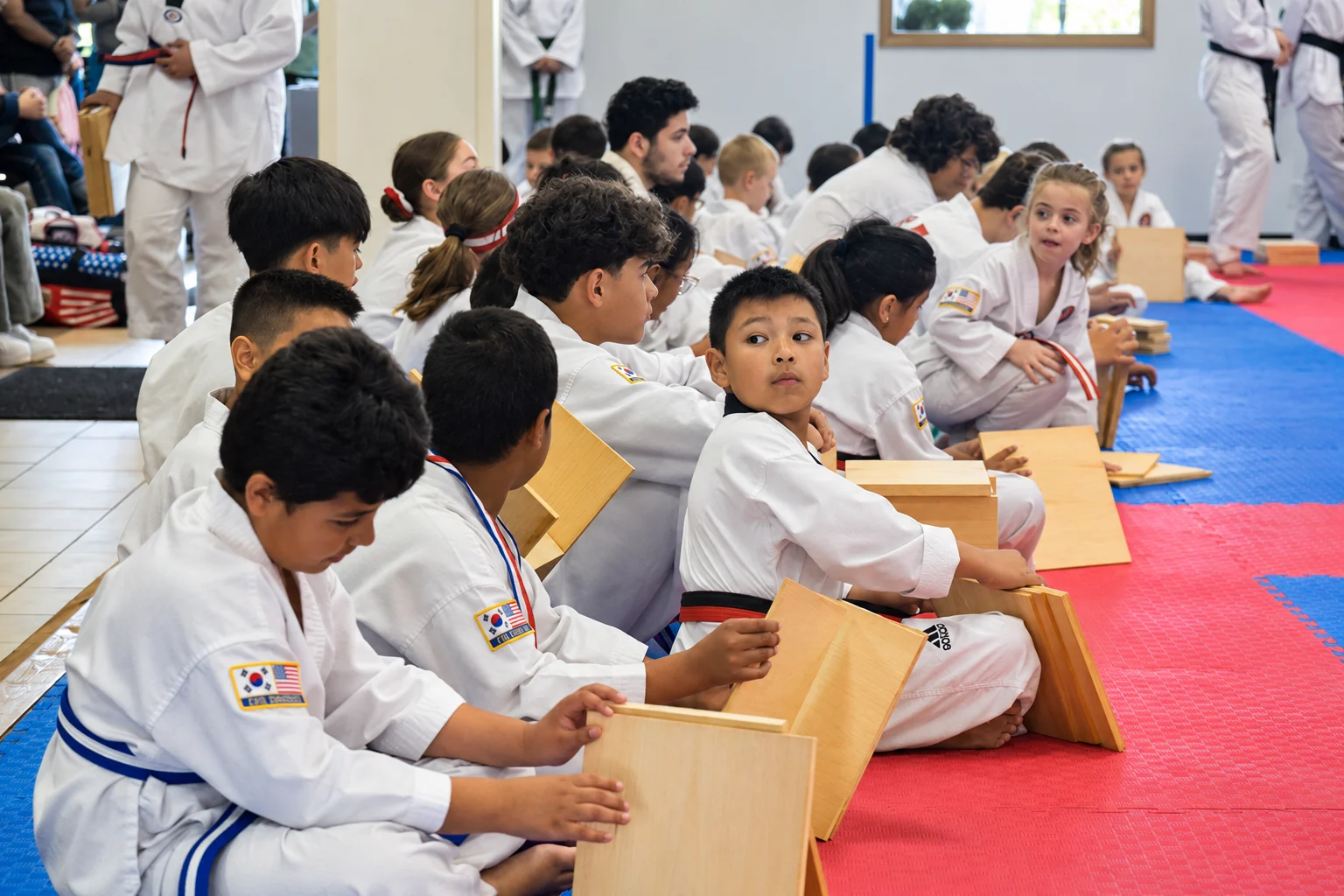
Taekwondo students bow to show respect and to mark a clear beginning or end to an interaction. At Korea Taekwondo Academy, the bow is not an act of submission or worship. It is a brief physical reminder: stop, pay attention, and approach training with humility.
World Taekwondo names respect among the sport’s core values.[1] Kukkiwon’s international master course also includes Taekwondo Courtesy as a formal part of instructor education.[2] Etiquette is not decoration around the kicks, forms, and other physical skills. It is part of how Taekwondo is taught.
A bow is a pause with a purpose
A good bow begins before the student bends forward. The student stops what they are doing, gives the other person their attention, and completes the greeting without rushing.
That short pause asks a student to practice several habits at once:
- Attention: Stop moving and notice the person or moment in front of you.
- Courtesy: Acknowledge instructors, senior students, and training partners.
- Humility: Enter the interaction ready to listen and learn.
- Self-control: Slow down enough to respond deliberately instead of carelessly.
A bow does not prove that a child is respectful, and it does not guarantee an overnight change in behavior. It gives students a repeated chance to practice respect in a visible, concrete way.
When do students bow at KTA?
Students learn bowing through greetings, class transitions, and other moments throughout training. New students are not expected to know every cue on the first day. Instructors show them what to do, explain why it matters, and help the routine become familiar over time.
The details are simple: pause, stand with attention, keep the hands free, face the person you are greeting, and complete the bow without turning it into a rushed nod. The goal is not empty formality. The goal is a sincere and attentive greeting.
Is bowing religious?
No. At KTA, bowing is taught as a respectful martial-arts greeting, not an act of worship.
Its purpose is similar to a handshake or a polite verbal greeting, but it also helps establish the focused atmosphere of a traditional Taekwondo class. Families with a specific question or concern are welcome to ask an instructor before or after class.
Why does this small habit matter?
KTA offers structured traditional Taekwondo training for children, teens, adults, and families in Noblesville.[3] Bowing supports that structure by giving students a consistent way to enter a class, acknowledge instruction, and move between activities with attention.
The physical techniques matter. So does the way students carry themselves while learning them.
Over time, students are not merely told to be respectful. They practice a respectful action again and again—when they are energetic, distracted, confident, nervous, or tired. That repetition is what turns etiquette from an idea into a habit.
How parents can help
Parents do not need to correct every bow from the lobby. The instructors can handle the technical details in class.
The most useful support is simple:
- Remind your child that bowing is a greeting, not something embarrassing.
- Encourage them to slow down and give the moment their attention.
- Let the instructor correct the details without making the child feel ashamed.
- Ask questions if a custom is unfamiliar or unclear.
Students will not perform every bow perfectly, especially when they are new. What matters is that they understand the purpose and keep practicing.
The next step
If your family is comparing martial arts schools in Noblesville, the best way to understand KTA’s class structure is to experience it in person. Review KTA’s programs and contact Korea Taekwondo Academy to arrange a visit.
Sources
[1] https://worldtaekwondo.org/inside/aboutwt/OurVisionMissionStrategy/contents — World Taekwondo: Vision, Mission, Strategy and Values
[2] https://wta.kukkiwon.or.kr/en/trainingProcess/masterCourse?lang=en&menuid=1073&topMenuid=1072 — Kukkiwon WTA: International Taekwondo Master Course
[3] https://ktausa.com/programs — Korea Taekwondo Academy Programs